March 2026 Cohort Recap
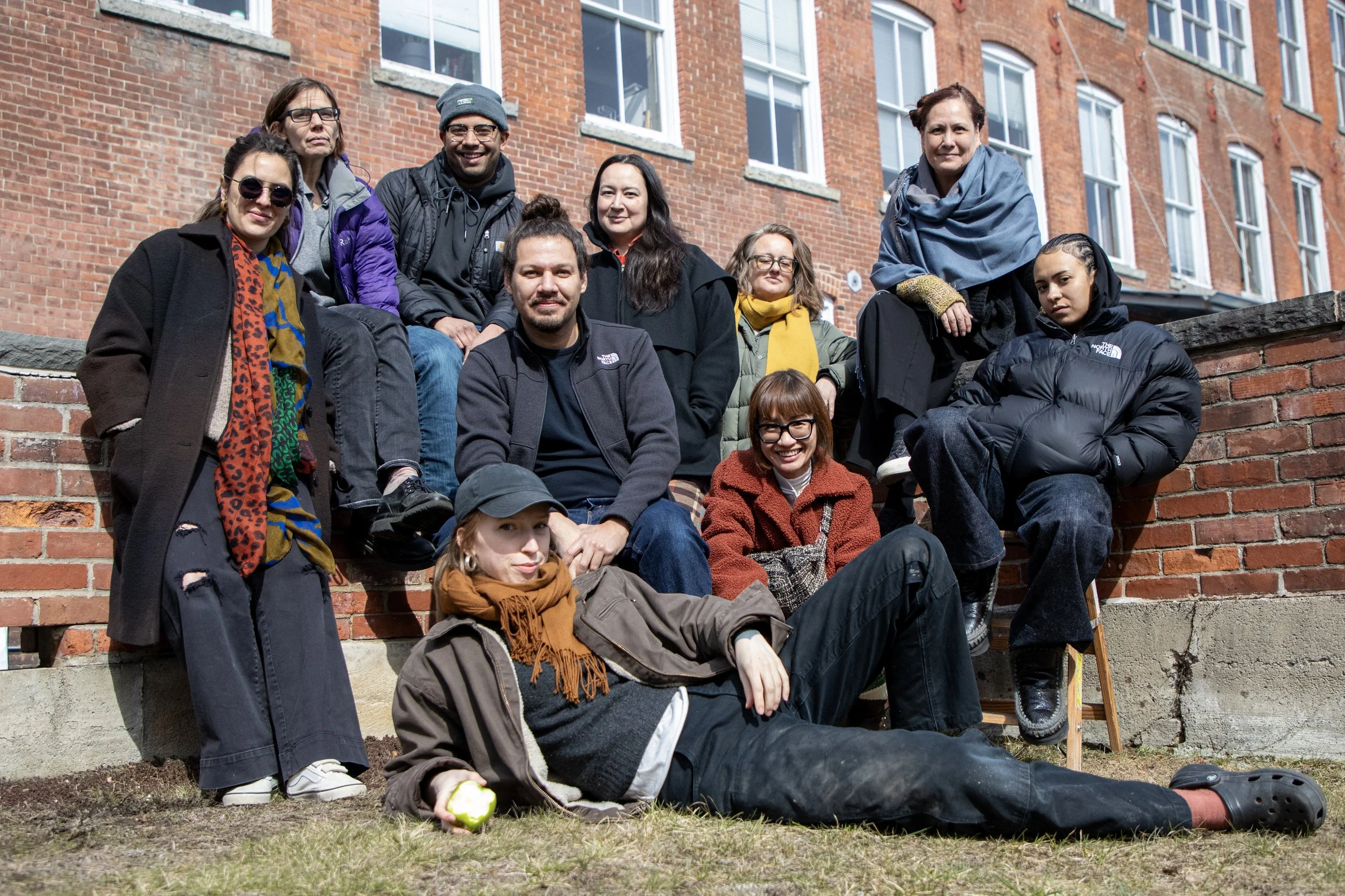
2026.03.12 Cohort
From left to right: Gabriela Passos, Spring Ulmer, Casey Fletcher, Jacobo Alonso, Michelle Min Sterling, Danielle Lazarin (Back), Ari Tabei (Middle), Monika Lin, Shani Strand, and Tyna Ontko (Front)
Photo by Thomas J. Logan.
Residency Session: March 12 — 24, 2026
Artists-in-residence
Studio 1
Michelle Min Sterling
Caroline K. Fulford is a librarian and writer from New Jersey living in Brooklyn. She received support from Sundress Academy for the Arts in 2024. In 2019, she won the Indiana Review Fiction Prize and an NYC Emerging Writers Fellowship from the Center for Fiction.
Her fiction is speculative and historical, finding the porosity between humanity and nature. She is working on a collection of short stories, in addition to a novel based on the Sullivanian psychotherapy cult of Manhattan's Upper West Side in sixties and seventies.
Studio 2
Spring Ulmer
Lynnée Denise is an interdisciplinary artist and writer working across sound, moving image, and research-based practice. Based between Amsterdam and Johannesburg, and originally from Los Angeles, her work examines music as a form of knowledge production, focusing on the visual, social, and political life of sound within Black Atlantic histories.
Her artistic practice is grounded in what she describes as turntable epistemology: a method that treats recorded music, albums, and their visual cultures as sites through which history is heard, read, and interpreted. Drawing from experimental sonic performance, film essays, and installation-based research, her work explores how sound operates as evidence—carrying political histories, migration trajectories, and mapping interconnections across time and place.
Denise has presented work internationally at institutions including Kunstinstituut Melly (Rotterdam), Tate Liverpool, Haus der Kulturen der Welt (Berlin), and the Musée d’ethnographie de Genève (MEG). Alongside her artistic practice, she has taught and contributed to artist development and research programs at institutions such as Sandberg Instituut, Rijksakademie van Beeldende Kunsten, Stanford University, and Goldsmiths, University of London, where she is completing a PhD in Visual Cultures.
Her award-winning debut book, Why Willie Mae Thornton Matters (2023), reflects her long-standing engagement with music as an archive of cultural and political life.
Studio 3
Danielle Lazarin
M. L. Rio has been an actor, a bookseller, an academic, and a music writer. An avid road-tripper and record collector, when she’s not on the hunt for her next big score, she lives in South Philadelphia with the world’s best road dog, Marlowe. She holds an MA in Shakespeare studies from King’s College London and Shakespeare’s Globe and a PhD in English from the University of Maryland, College Park. Her bestselling first novel, IF WE WERE VILLAINS, has been published in 22 countries. Her first novella, GRAVEYARD SHIFT, was a USA Today and Sunday Times bestseller. Her second novel, Hot Wax, published in September 2025 by Simon & Schuster, was a USA Today and ABA Indie bestseller.
Studio 4
Aricoco
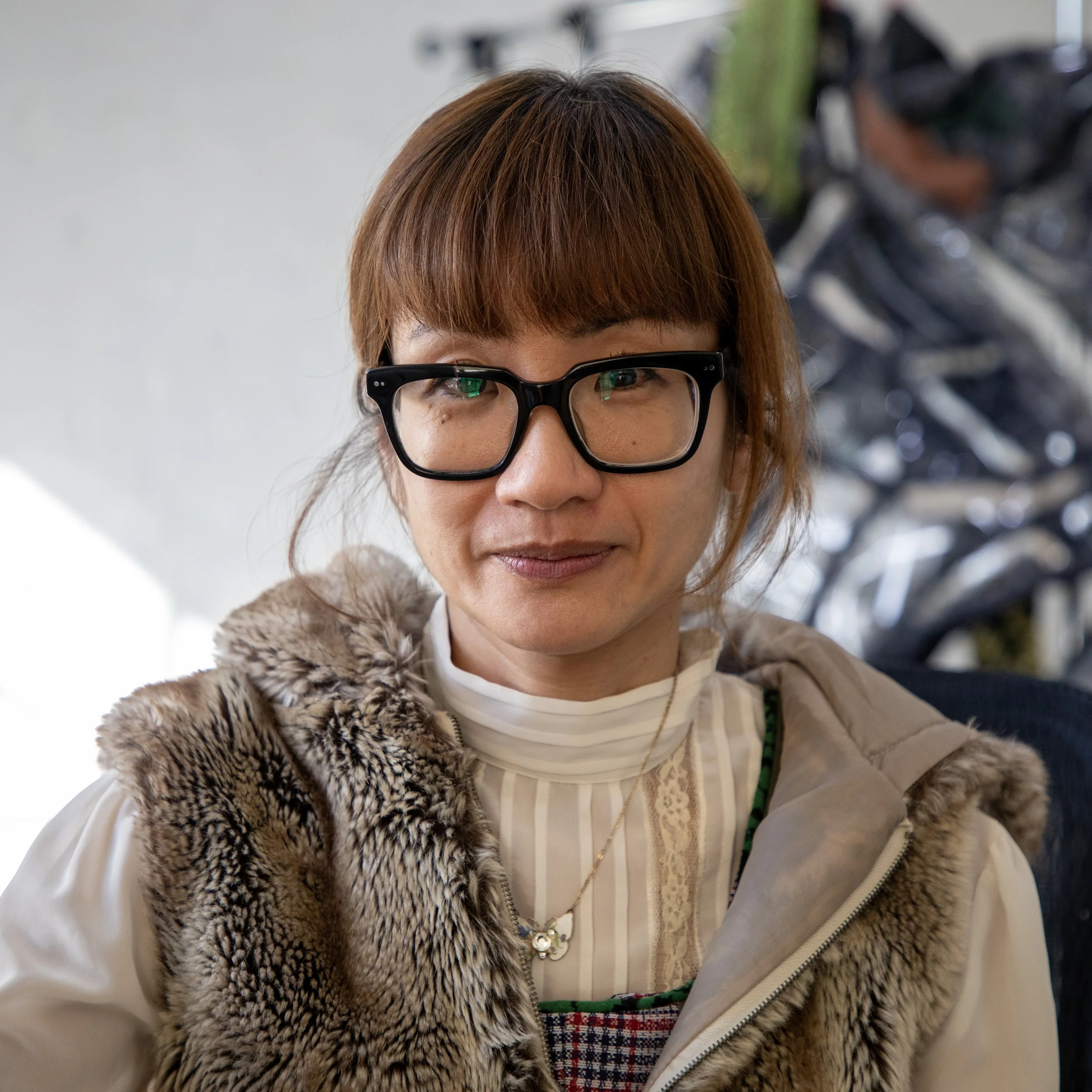
aricoco (Ari Tabei), born and raised in Tokyo, is an interdisciplinary artist, based in NYC. After earning her MFA from University of Connecticut in sculpture and video performance art in 2007, she moved to NYC to exhibit and perform extensively in the city. She was awarded LMCC Creative Engagement Fund in 2020 and New York City Artist Corps Grant in 2021 to continue working on her socially-engaged collaborative project PIPORNOT, which had been launched in 2016. Recently, she has joined the Repair Cafe El Barrio as the community's artist liaison to help develop their new educational programming.
aricoco is interested in how human communities might form and thrive without centralized leadership and power privilege. Exploring the non-hierarchical system of social insects (especially ants) and their biological altruistic characteristics within their female-dominated society, she attempts to acknowledge her paradoxical phobia for insects and challenge her own vulnerability as a human, drawing a parallel with the life of an insect. Through creating environments for habitation, sculptural garments/bags and masks that serve as her protective gear, she disguises herself as an insect, performing a ritualistic play of surrendering her “powerless” body to the habitat.
Studio 5
Casey Fletcher
Victoria Dugger (b. 1991, Columbus, Georgia) is a visual artist based in Athens, Georgia. She earned her BFA from Columbus State University in 2016 and her MFA in Painting from the Lamar Dodd School of Art at the University of Georgia in 2022. Dugger made her New York solo debut with Out of Body at Sargent’s Daughters in July 2021, followed by her second solo exhibition, Tough Love, in 2024. Her work has been featured in Vogue, Artforum, Hyperallergic, artnet, ARTnews, Whitehot Magazine, and artdaily. In 2023, she was recognized as a Georgia Woman to Watch by the National Museum of Women in the Arts and was featured in FRIEZE and The New York Times. Dugger was the winner of the 2023 South Arts Southern Prize and the 2024 Hudgens Prize. Most recently, she was awarded a 2024 MacDowell Fellowship and was on the cover and featured artist of the Spring 2025 Georgia Review. She is represented by Sargent’s Daughters.
In my practice, I wrestle with the complex intersections of identity, disability, and southern heritage, weaving together personal histories and societal narratives. As a disabled Black woman, I confront the layers of isolation, desire, and visibility in my work, reimagining the Southern Gothic through the lens of lived experience. My art is an exploration of vulnerability, the grotesque, and beauty—seemingly contradictory elements that I allow to coexist, much like the fractured, multifaceted identities I embody. I lean into the spectacle of femininity, layering pearls, frosting, and glitter with fragmented limbs, drawing from both art historical traditions and contemporary expressions of Black womanhood. My figures become exaggerated, anthropomorphic stand-ins for my own body, their elongated, tangled forms adorned with markers of both opulence and decay. Through these characters, I investigate the performative nature of survival in a world that renders bodies like mine both hyper-visible and invisible. Grounded in southern domestic iconography, my pieces reference the tension between familiarity and alienation, pushing the boundaries of comfort with elements of body horror, humor, and vibrant excess. By distorting the line between what is grotesque and what is desirable, I aim to question the boundaries of beauty and deformity, tenderness and violence, offering a space for bodies that refuse to be easily understood, controlled, or contained. I build my work from an ambivalent relationship with girlhood and femininity, where the vibrancy of childhood memories collides with the harshness of navigating adult realities as a disabled woman. It is a reflection on the labor of bending over backwards to fit into spaces not made for us, and the quiet power of those moments when we reclaim space on our own terms. Through this visual language, I seek to create empathetic portals—inviting viewers into a world where the boundaries of identity blur, where possibilities open, and where tenderness resides alongside resistance.
Studio 6
Tyna Ontko
Shemona Goldman is a composer, sound artist, and sculptor whose practice investigates conductivity, resonance, and signal transmission as material and ethical conditions. Working across experimental composition, electronic systems, and sculptural installation, she develops open musical environments shaped by environmental and infrastructural forces.
Her work centers on copper and silver as conductive media, examining oxidation, surface memory, and resonance decay through radios, transducers, hydrophones, and custom-built circuits. These systems embed improvisation and aleatoric processes within material structures, allowing sound to emerge through instability, feedback, and responsive tuning.
Goldman’s MFA thesis in Music and Sound at Bard College, Pluralistic Audibilities, integrated sculptural installation, microtonal performance, and radio transmission with critical research into diasporic epistemology and cybernetic theory. Across her practice, she approaches composition as an infrastructural act accountable to social, historical, and ecological conditions.
She lives and works between Toronto and New York.
Studio 9
Gabriela Passos
Sally Scopa is a painter based in Bellingham, Washington.
Painting brings me a sense of stillness and presence in the here and now; each of my pieces is an invitation to the viewer to share in this focused state. While my paintings can look puzzle-like and mathematical, they take shape intuitively over time and, ideally, surprise me. I work in layers, sanding back down to excavate previous versions of the piece and allowing decisions to accumulate organically, each in response to the one before.
The content of my work changes often, but what remains consistent is an emphasis on the peacefulness of painting: the physical sensations of looking and painting that allow someone to exist in the present moment. Right now, I'm thinking about Rube Goldberg machines, pre-cinema, aquariums, molecular diagrams of the human body and geographical strata as starting points for my work.
Studio 10
Shani Strand
In an interview, jazz pianist Duke Ellington was asked where he found inspiration. His response has stayed with me: “I got a million dreams. It's all I do is dream. All the time.” When the interviewer countered, “I thought you played piano,” Ellington turned, played the piano in front of him and said, “No, this is dreaming.” That line resonates deeply with me and inspires my practice.
I am a 24-year painter, printmaker, and sometimes writer. I spend my days dreaming—transforming those dreams into short stories and making them into printed fabric. My work focuses on fusing painting and silkscreen. My work creates internal landscapes by using tie and dye, silkscreen, oil pastel, and anything else that feels right to explore and express those dreams. I will use anything (truly anything) to achieve my vision. My process is intuitive, impulsive, spiritual, ritualistic, and reassuring. Similarly to Ellington thinking about his work as a type of dreaming and a place to derive inspiration from, I use daydreaming as a mode of storytelling. I am using dreams as a way to envision a new way of existence. I approach dreams as liberation and a way to exist safely. In my dreams I do not have a body. I do not have bad days. I can explore possibilities in my fabricated realities. In these dreams there is no winter and it is easy to live. I do cartwheels in the tall grass and eat watermelon with my grandmother. My practice includes recreating these feelings via the process and begins to further realize them by creating a tangible object.
Influences: Sun Ra, repetition/ ritual, my grandmother, church, romance, John Coltrane, yearning, Jazz, unspoken words, impressionist paintings, Barry White, sunshine, angels, moon gazing, smelling a lovers unwashed scalp, warm lighting, Billie Holiday, Blues, skin, and dirt (v) (the act of being dirty)
Studio 11
Monika Lin
Daria Irincheeva is a female Russian-born US citizen artist of mixed heritage, North-Eastern European (Russian, Latvian, Lithuanian Jewish) and Indigenous Siberian (Buryat Khongodor tribe), whose work delves into themes of displacement, political violence, and cultural erasure. Her practice is deeply informed by her family’s experiences during the Holocaust, Soviet repression, and forced displacement, as well as her estrangement from Russia due to her opposition to the invasion of Ukraine.
Irincheeva holds an MFA from Columbia University (2018) and has exhibited internationally, with solo shows at the Pushkin House (2024) and Moscow Museum of Modern Art (2019), among others; and group shows in Venice Biennial parallel program (2019), Albertina Museum, Vienna, Austria (2014), among numerous others. Her work has been featured in The New York Times, Frieze, and Artforum, and she currently lives and works in Upstate NY.
Studio 12
Jacobo Alonso
Mai Snow is a Trans/Non-binary artist born in Polevskoy, Russia. They split their time living and making work between Valentine, Texas and New England. Their work focuses on beauty and complexities of queer sexuality, trans gender and the non-binary body. Snow received their MFA from University of Texas at Austin in 2020 and their BFA from Maine College of Art in 2013. They have shown their paintings throughout Texas, New England, and in various parts of the Midwest. Snow is the co-creater of a local DIY Gallery space, Shedshows, in Austin, Texas.
I am a Trans/Non-binary painter. My work focuses on beauty and complexities of queer sexuality, trans gender and the non-binary body. In my work I am exploring the queer “american” trans dream. Through the language of painting I am exploring these waking realities with questions of separateness of genders, relevance in color, and delight of persistence of a trans body in a Texan and overall normative American culture